
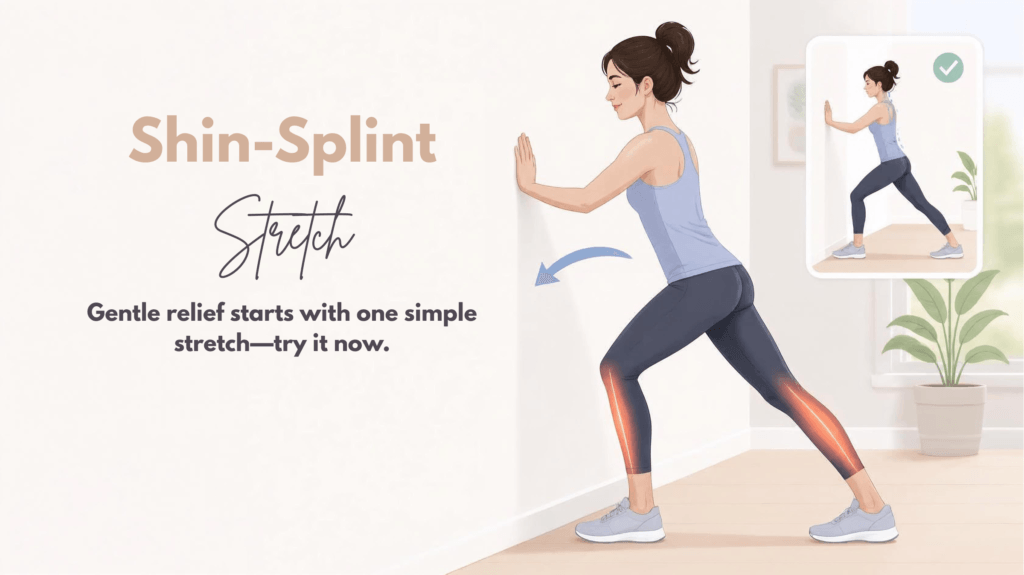
If your shins are burning, aching, or feeling painfully tight after a run, walk, or workout, you probably want one thing: relief right now. The good news is that gentle shin splint stretches can help reduce the feeling of tightness around your lower legs, especially when your calves, ankles, and muscles at the front of your lower leg are contributing to the problem. But stretching is not a magic switch that instantly heals irritated tissue, and forcing an aggressive stretch can actually make an already painful leg feel worse.
Shin splints, medically called medial tibial stress syndrome (MTSS), commonly develop when your training load increases faster than your body can adapt. Running more miles, adding hills, exercising on hard surfaces, or suddenly increasing workout intensity can place repeated stress on the muscles, tendons, and bone tissues around the shin. Mayo Clinic notes that shin splints commonly affect runners and can initially improve when exercise stops, although persistent pain can signal a more serious bone injury.
So, what can you do when your shins hurt after exercise? Start gently. This guide walks you through four practical stretches: a kneeling shin stretch, a seated toe pull, a straight-leg calf stretch, and a bent-knee soleus stretch. The goal is not to force the pain away. Instead, think of these movements as turning down the tension around your lower leg while you also give the irritated tissues time to recover.
Looking for full-body relief? Explore our complete library of Daily stretch routines for every muscle group.
Why Your Shins Hurt After Running or Exercise
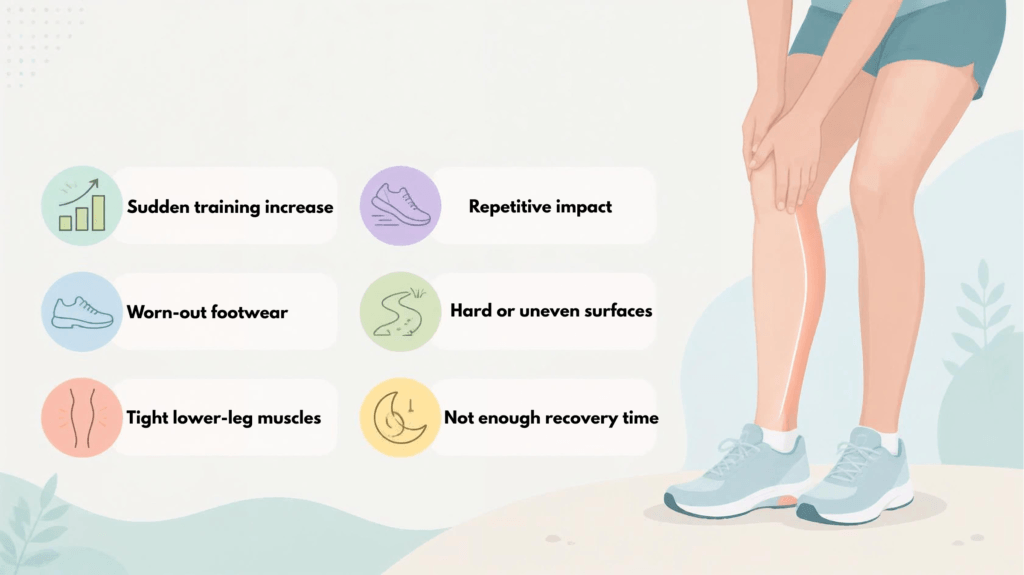
Shin pain occurs when your lower leg’s workload exceeds its capacity to handle impact, much like overworked car shock absorbers. Suddenly increasing your running distance, speed, frequency, or hills—especially on hard surfaces—causes repetitive stress along the shinbone (medial tibial stress syndrome), leading to inflammation in the surrounding muscles, tendons, and bone tissue.
Because calf tightness and limited ankle mobility force lower leg muscles to overcompensate, simply stretching the front of your shin isn’t enough. A complete recovery requires a balanced approach: gently stretch both the shins and calves, temporarily scale back triggering activities, and gradually rebuild lower leg strength.
What Happens to the Muscles and Tissues
During running, your ankle and foot are constantly moving through a controlled sequence of loading and push-off. The muscles at the front of your lower leg help control the foot as it moves toward the ground, while the calf complex contributes heavily during propulsion. If your training volume suddenly jumps, these tissues may become fatigued and sore.
This does not mean that every painful shin is simply a “tight muscle.” Shin splints involve more than muscular tightness, which is why stretching should be viewed as one part of recovery, rather than the entire treatment. Mayo Clinic recommends reducing or avoiding activities that cause pain and using low-impact activities such as swimming or cycling while symptoms settle.
The practical takeaway is simple: if a stretch feels like a mild pulling sensation, it may be reasonable to continue gently. If it produces sharp, pinpoint, worsening, or deep bone pain, stop. Your goal is to create comfortable movement—not to win a flexibility contest.
Before You Stretch: Check Your Pain
Before trying any shin splint stretches, take a moment to assess what you are feeling. Typical shin splint symptoms may include aching, tenderness, or pain along the inner side of the shin, often associated with exercise. In earlier stages, discomfort may settle when you stop the activity. That pattern can be different from an injury that produces very localized bone tenderness or pain that continues during rest.
This distinction matters because stretching is not appropriate for every cause of shin pain. A stress fracture is a small crack in the bone caused by repetitive loading, and it can occur when training increases too quickly. Mayo Clinic explains that stress-fracture pain often becomes worse with weight-bearing activity and may eventually occur at rest or at night.
Shin Splints vs. a Stress Fracture
| Sign | More consistent with shin splints | Possible stress fracture |
|---|
| Pain location | Often spread along a broader area of the shin | Often concentrated at one specific spot |
| Trigger | Commonly related to increased running or training | Often follows repetitive loading or a training increase |
| Stretching | Gentle stretching may feel comfortable | Stretching may not improve the underlying pain |
| Rest | Early symptoms may improve when activity stops | Pain can progress and may occur at rest |
| Bone tenderness | Usually less sharply localized | Point tenderness can be concerning |
| What to do | Reduce aggravating activity and recover | Stop impact activity and seek medical evaluation |
This table is a guide, not a diagnosis. If you have point tenderness directly over the bone, swelling, worsening pain, pain while walking, or pain at rest or at night, do not try to stretch through it. Stress fractures sometimes require imaging to identify, and Mayo Clinic notes that an MRI can be particularly useful when a stress fracture is suspected.
4 Shin Splint Stretches for Fast Relief
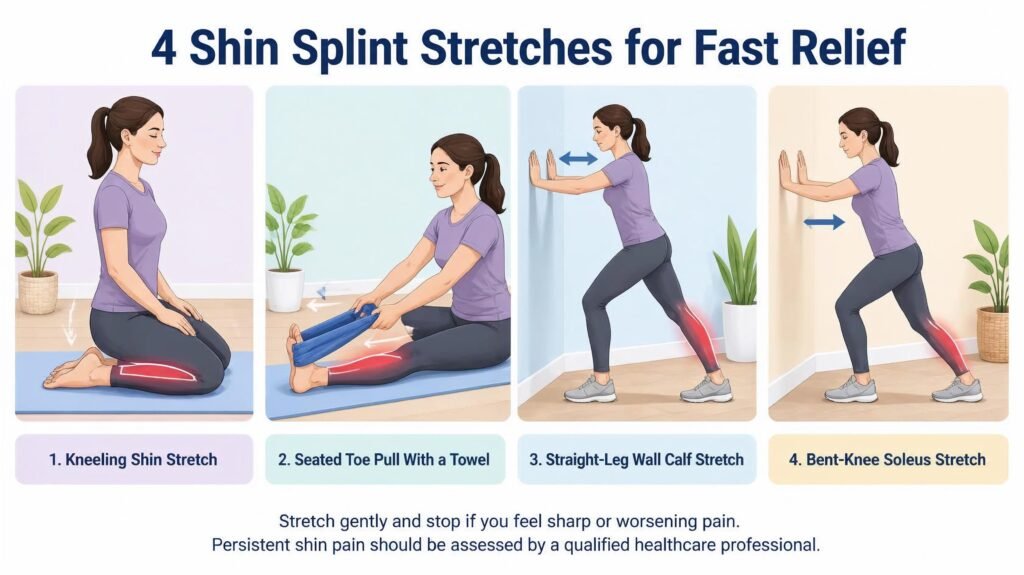
If your symptoms are consistent with ordinary exercise-related shin splints and gentle movement feels comfortable, you can try the following sequence. None of these stretches should produce sharp pain. Aim for a mild, controlled pulling sensation and breathe normally instead of holding your breath.
The idea is to work around the entire lower leg rather than repeatedly attacking one painful spot. Start with the front of the lower leg, then address the calf muscles that influence ankle movement. Sports Medicine Today also recommends calf stretching and a gentle front-of-ankle stretch as part of managing shin splint symptoms.
1. Kneeling Shin Stretch
The kneeling shin stretch targets tight muscles along the front of your ankle and lower leg after running or jumping. Because this position places significant weight on the ankles, ease into it slowly on a cushioned surface.
To perform it, kneel with your knees together, the tops of your feet flat on the floor, and toes pointing backward. Slowly sink your hips toward your heels until you feel a gentle pull across the front of your leg or ankle. Hold for 10–20 seconds and repeat 2–3 times.
Always prioritize a mild stretch over maximum range—forcing your ankles deeper into an already irritated range of motion will only cause further inflammation. If you feel sharp pressure or pain, add extra padding under your feet or switch to a seated toe-pull stretch.
2. Seated Toe Pull With a Towel
If kneeling is uncomfortable, a seated toe pull with a towel gives you more control over the amount of stretch. Sit on the floor or on a firm surface with one leg extended. Loop a towel or strap around the front of your foot, holding both ends in your hands.
Gently pull the towel toward you so that your foot moves into a controlled position. Do not yank the foot or aggressively pull the toes. Hold for about 15–20 seconds, relax, and repeat 2–3 times on each side.
The important part is the sensation. You are looking for gentle tension through the lower leg and ankle rather than sharp pain directly over the shinbone. If you feel pain at a specific point on the bone, stop rather than trying to “stretch through” it.
This movement can also help you compare sides. Does one ankle feel dramatically tighter than the other? Does one side become painful much sooner? Those differences can give you useful information about your current mobility, but they do not automatically identify the cause of your shin pain.
3. Straight-Leg Wall Calf Stretch
Now shift your attention to the gastrocnemius, the larger calf muscle. Stand facing a wall and place both hands against it. Step one foot behind you, keep that back knee straight, and press the back heel toward the floor while bending the front knee.
Keep your back foot pointing roughly forward rather than allowing it to rotate dramatically outward. Lean your body toward the wall until you feel a steady stretch in the upper portion of your back calf. Hold for 20–30 seconds, relax, and repeat 2–3 times per side.
This stretch is useful because your calf complex plays a major role in ankle movement during walking and running. If the calf is stiff, your lower leg may have to work harder to control movement. Sports Medicine Today specifically recommends calf stretching for people dealing with shin splint symptoms.
Do not bounce. A slow, steady stretch is easier to control and allows you to recognize whether the sensation is muscular tension or something more concerning. If the stretch produces pain along the shinbone rather than a comfortable calf stretch, reduce the range or stop.
4. Bent-Knee Soleus Stretch
The soleus sits deeper within the calf and works alongside the gastrocnemius. To target it, use a similar wall position but bend the back knee slightly. Keep the back heel grounded while slowly moving your knee forward toward the wall.
You should feel the stretch lower in the calf and around the Achilles region rather than high behind the knee. Hold for 20–30 seconds, perform 2–3 repetitions, and keep the movement gentle.
Why use both calf stretches? Because bending the knee changes how the calf muscles are loaded. A straight-knee stretch emphasizes the gastrocnemius more, while the bent-knee position gives the deeper soleus a greater role. You do not need to force either position. Think of the two stretches as covering different parts of the same system.
If your shin pain increases during the exercise, stop. The purpose is to improve comfortable mobility while reducing unnecessary tension—not to prove that you can tolerate discomfort.
The Best Stretching Sequence for Immediate Relief
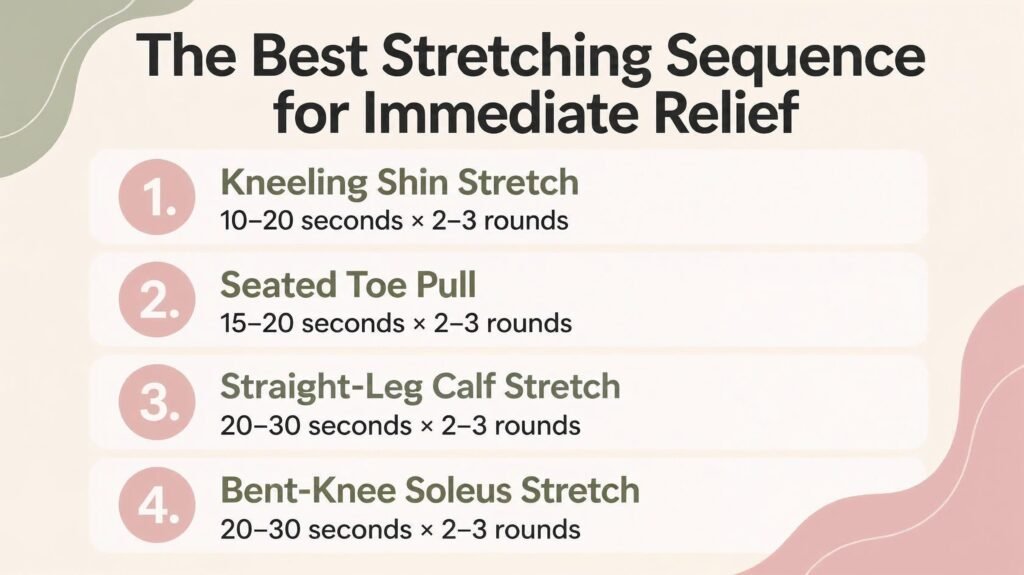
If you are looking for a simple routine to follow after your workout, keep it uncomplicated. Start with the kneeling shin stretch or seated toe pull, then move into the straight-leg wall calf stretch, and finish with the bent-knee soleus stretch. This gives you a balanced approach to the front and back of the lower leg without spending half an hour stretching.
Try this sequence:
- Kneeling shin stretch: 10–20 seconds × 2–3 rounds.
- Seated toe pull: 15–20 seconds × 2–3 rounds.
- Straight-leg calf stretch: 20–30 seconds × 2–3 rounds.
- Bent-knee soleus stretch: 20–30 seconds × 2–3 rounds.
You should finish feeling looser, not more painful. If your pain is noticeably worse afterward, stretching is not the answer for that particular flare-up. Reduce the aggravating activity and consider using ice for pain relief; Mayo Clinic recommends ice for about 15–20 minutes at a time several times daily for shin splints.
How Long Should You Hold Each Stretch?
You do not need to hold a stretch for several minutes to get useful mobility work. For an irritated lower leg, shorter and gentler holds are often easier to tolerate. Start at the lower end of the suggested range and increase only if the movement consistently feels comfortable.
Think of stretching like turning a stiff steering wheel. You do not need to yank it as hard as possible. You apply steady pressure, allow movement to happen, release, and repeat. The same principle applies here: controlled repetition beats aggressive stretching.
Also remember that immediate relief does not necessarily mean the injury has healed. Pain can temporarily decrease while the underlying tissues remain overloaded. If you stretch your shins and then immediately go back out for the same run that caused the problem, you may simply repeat the cycle.
Common Stretching Mistakes That Make Shin Pain Worse
| Common mistake | Why it can backfire | Better modification |
| Stretching into sharp pain | Pain may indicate irritation or another injury | Keep the stretch mild and comfortable |
| Bouncing during the stretch | Makes the movement harder to control | Use slow, steady holds |
| Only stretching the front of the shin | Calf stiffness may also contribute to movement problems | Include straight- and bent-knee calf stretches |
| Stretching immediately before another painful run | Mobility does not remove the original overload | Reduce or replace the aggravating activity |
| Holding your breath | Encourages unnecessary tension | Breathe slowly throughout |
| Assuming all shin pain is shin splints | Stress fractures and other conditions can mimic symptoms | Watch for localized or persistent pain |
| Doing too much because it feels good temporarily | Temporary relief does not equal tissue recovery | Pair mobility with load reduction and gradual return |
One of the most common traps is chasing the sensation of a “deep stretch.” When your shin hurts, it can feel logical to attack the tightest area harder. But irritated tissue does not always respond better to more force. If a stretch makes your symptoms sharper, more localized, or progressively worse, back off.
Another mistake is ignoring the reason the pain started. If you added five miles to your weekly running volume, started sprinting hills, or returned to exercise after a long break, the solution cannot simply be four stretches. Your body needs time to adapt to the new workload. Mayo Clinic recommends increasing activity gradually and using lower-impact cross-training while symptoms recover.
When to Stop Stretching and Rest

Differentiate between normal muscle tension and pain that requires immediate rest. A gentle stretch may feel uncomfortable, but it should never cause sharp, stabbing, or worsening pain. If stretching increases your pain, reduce the intensity or stop entirely.
Broad soreness along the inner shin is common with shin splints, but sharp tenderness on a specific point over the bone, pain at rest, or pain that wakes you at night signals a potential stress fracture. Do not try to stretch through a suspected bone injury—stop weight-bearing activities and seek a professional medical evaluation to allow proper healing.
How to Get Rid of Shin Splints Fast
The fastest route to recovery isn’t doing more—it’s removing the trigger causing the irritation. If running causes shin pain, temporarily reduce it rather than trying to mask symptoms with stretching. You can maintain fitness with low-impact alternatives like swimming, cycling, or water running, as long as they remain pain-free.
For short-term relief, apply a towel-wrapped ice pack to the area for 15–20 minutes several times a day. Once symptoms settle, gradually return to your normal routine. Most importantly, identify what overloaded your lower legs initially—such as a sudden jump in mileage, switching to hard surfaces, or adding hill workouts—so you can prevent the cycle from repeating.
Adjust Your Running and Walking
Once symptoms settle, avoid immediately jumping back to your peak training volume. Resume below the threshold that triggered pain and build up gradually, focusing on strength, cross-training, and smart workload progression.
Check your gear: worn-out or ill-fitting footwear can contribute to lower leg strain. Consider replacing running shoes every 350–500 miles (560–800 km). Finally, if shin splints repeatedly return, get your running mechanics evaluated by a physical therapist or sports medicine professional to address underlying gait, strength, or mobility issues.
Prevent Shin Splints From Coming Back
Once the pain disappears, the goal changes from relief to resilience. Stretching can support mobility, but strength and sensible training progression are equally important. Your lower legs need to tolerate the forces you are asking them to handle.
A strong prevention strategy pairs gradual workload progression with strengthening for your lower legs, ankles, hips, and core. Avoid increasing speed, distance, and hills simultaneously—give your body a manageable challenge followed by adequate recovery.
Use low-impact cross-training like swimming or cycling to maintain cardiovascular fitness while protecting your shins from repetitive impact. Above all, track pain trends: if soreness appears earlier in your workouts, lingers longer, or hurts during daily walking, stop pushing and get evaluated by a professional.
Conclusion
Effective shin splint stretches are gentle, controlled, and part of a broader recovery strategy. While stretches for the front shin, ankles, and calves reduce tightness, stretching alone won’t fix pain caused by repetitive stress.
True recovery requires reducing the activity that caused the overload, resting from painful impact, and returning to sport gradually. If your pain is sharply localized, persists at rest, or makes walking difficult, consult a professional to rule out a stress fracture. Once immediate pain subsides, focus on a consistent lower-leg strengthening routine to build resilient muscles and prevent future flare-ups.
Looking for full-body relief?
Explore our complete library of Daily stretch routines for every muscle group.
Frequently Asked Questions
Q1. What is the best stretch for shin splints?
There is no single best stretch for everyone. A gentle kneeling shin stretch can address the front of the ankle and lower leg, while straight- and bent-knee calf stretches address the calf muscles. The best option is the one that produces comfortable tension without increasing your pain. If stretching makes the symptoms worse, stop rather than forcing the movement.
Q2. How do you stretch out shin splints?
Start with gentle mobility rather than aggressive stretching. Try a kneeling shin stretch or seated toe pull, followed by a straight-leg calf stretch and a bent-knee soleus stretch. Hold each position for roughly 10–30 seconds and repeat 2–3 times, depending on comfort. Remember that stretching can help with mobility and muscle tension, but reducing the activity that caused the overload is also an important part of recovery.
Q3. Can stretching make shin splints worse?
Yes, particularly if you stretch aggressively or continue despite sharp pain. A mild pulling sensation can be acceptable, but stabbing, localized, worsening, or deep bone pain is a reason to stop. If symptoms repeatedly worsen after stretching, focus on reducing the aggravating activity and consider getting the pain assessed.
Q4. How can I get rid of shin splints fast?
The quickest approach is usually to stop or reduce the activity that is causing pain rather than trying to stretch through it. Rest from painful impact, consider low-impact exercise if it is comfortable, and use ice for short-term pain relief. Then gradually return to running or other impact activity after symptoms have settled. Mayo Clinic recommends gradual progression rather than suddenly returning to the previous training load.
Q5. How do I know if my shin pain is a stress fracture?
A stress fracture can cause pain that becomes progressively worse with weight-bearing activity and may eventually occur during rest or at night. Pain that is highly localized to one spot on the bone is particularly concerning compared with broader shin soreness. Because shin splints and stress injuries can overlap in symptoms, persistent or suspicious pain should be evaluated by a healthcare professional rather than treated with stretching alone.