
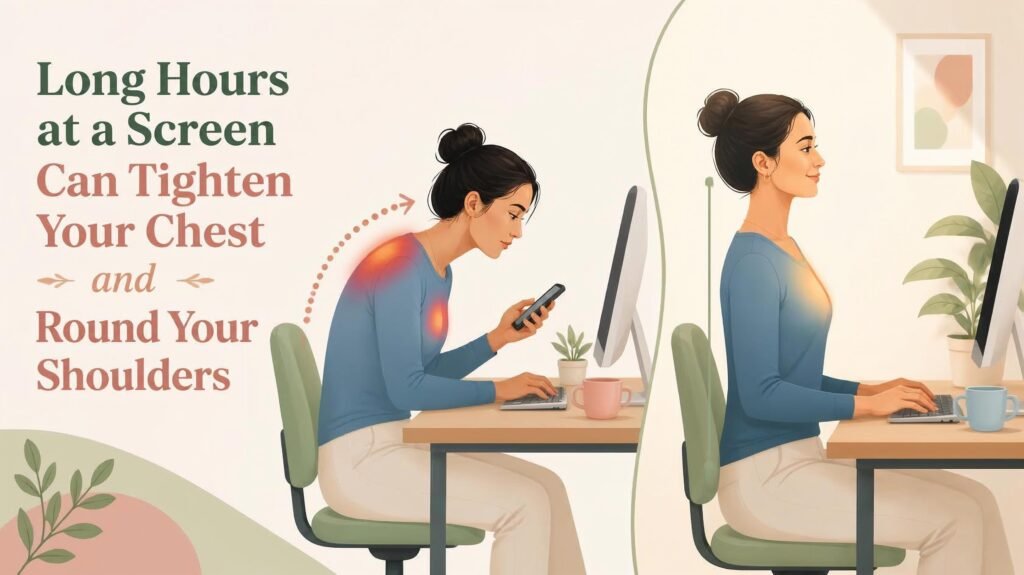
If you spend six or more hours a day sitting at a computer or looking down at a phone, tight chest muscles may be contributing to forward-head posture, rounded shoulders, and upper-back discomfort. When you remain slouched over a desk, your pectoral muscles rest in a constantly shortened state, pulling your shoulders inward and straining the muscles across your shoulder blades. Incorporating simple chest stretches throughout your workday is one of the most effective ways to counteract this forward collapse and restore natural alignment.
The good news is that gentle chest mobility exercises, regular movement breaks, ergonomic adjustments, and upper-back strengthening can help improve comfort and posture over time. Taking just two minutes every few hours to perform targeted chest stretches—such as opening your arms wide, using a nearby doorway, or pressing your shoulders back against a wall—instantly opens up the front of your body, improves shoulder joint mobility, and allows your lungs to expand fully for deeper breathing. Pairing these daily chest stretches with a monitor set at eye level and occasional desk breaks creates a sustainable routine that actively prevents chronic tension before it starts.
Pair these Chest Stretches moves with our broader stretching routines for maximum mobility and recovery.
AI Overview answer: Chest stretches can help desk workers by reducing tightness in the pectoral muscles, allowing the shoulders to move back more comfortably while improving upper-body mobility; lasting posture improvement also requires movement breaks, ergonomic changes, and strengthening.
How Desk Work Tightens Your Chest
Prolonged sitting often places the head in front of the shoulders and the arms forward toward a keyboard, mouse, or phone. Over time, this position may make the chest and front-of-shoulder muscles feel stiff while the muscles that support the neck and shoulder blades become less active.
This pattern is commonly described as upper crossed syndrome: tightness in the chest and neck muscles combines with weakness or reduced endurance in certain upper-back and deep-neck muscles. Research reviews suggest that posture-focused exercise and ergonomic interventions may improve pain and function in people with this pattern. PubMed
Why Rounded Shoulders Can Cause Upper-Back Pain
When the pectoralis major and pectoralis minor remain shortened, they can pull the shoulders forward and inward. The upper-back muscles then work harder to keep the head, neck, and shoulder blades supported.
This does not mean that one “bad” posture automatically causes pain. Instead, staying in one position for too long, using an unsuitable workstation, and lacking strength or movement variety can increase stress on the neck, shoulders, and upper back. Regular exercises that combine stretching, strengthening, and aerobic movement may help reduce work-related stiffness and discomfort. Honk Kong Adventist Health
Signs Your Chest Muscles May Be Tight
Tight chest muscles can feel different from person to person, but common signs include:
- Shoulders that naturally rest forward or appear rounded.
- A pulling sensation across the chest when you try to sit tall.
- Pinching or stiffness at the front of the shoulder.
- Upper-back tightness after computer or phone use.
- Difficulty letting the backs of your shoulders rest comfortably against a wall.
- Arms that do not relax easily at your sides.
- Reduced comfort when reaching overhead.
- A tendency to breathe shallowly or lift the shoulders while inhaling.
- Neck fatigue from holding the head forward.
- Temporary relief when you stand, walk, or open your arms.
These signs are not a diagnosis of tight pectoral muscles. Shoulder, neck, rib, nerve, or other conditions can cause similar symptoms.
The 10-Second Desk Self-Check
Try this gentle screen while seated:
- Sit near the front of your chair with both feet supported.
- Let your arms rest naturally by your sides.
- Slowly draw your chin back without looking up.
- Relax your shoulders and gently lengthen through the crown of your head.
- Notice whether your chest feels tight, your shoulders immediately round forward, or your upper back strains to maintain the position.
- Hold for approximately 10 seconds, then relax.
This is only a mobility and awareness check—not a clinical test. Stop if you feel pain, numbness, tingling, dizziness, or symptoms traveling into the arm.
The 5 Best Chest Stretches for Desk Workers
The following stretches target different areas of the chest and front shoulder. Move slowly, breathe normally, and aim for mild tension rather than pain. A stretch should not cause sharp, burning, electric, or worsening discomfort.
1. Doorway or Corner Chest Stretch
The doorway stretch is a practical option for opening the chest because it uses the frame for support while encouraging the shoulders to move gently behind the body.
How to do it
- Stand in a doorway or face the corner of a room.
- Place your forearms against the door frame or walls, with your elbows roughly at shoulder height.
- Step one foot forward and keep your ribs relaxed rather than flaring them upward.
- Gently shift your body forward until you feel a stretch across the chest and front of the shoulders.
- Keep your neck relaxed and avoid forcing the elbows backward.
- Breathe slowly and return to the starting position.
Recommended dose
- Hold for 20–30 seconds.
- Repeat 2–3 times.
- Perform once or twice daily, or during a work break.
Common mistakes to avoid
- Leaning so far forward that the shoulder pinches.
- Arching the lower back or thrusting the ribs forward.
- Shrugging the shoulders toward the ears.
- Bouncing into the stretch.
- Holding your breath.
Modification: If your shoulders are sensitive, place your elbows slightly below shoulder height and use a smaller forward step.
2. Seated Goalpost or Open-Book Stretch
The seated goalpost position gently places the shoulders in an open position without requiring a doorway, floor space, or exercise equipment.
How to do it
- Sit tall with your feet flat on the floor.
- Bend your elbows to approximately 90 degrees, forming a goalpost shape with your arms.
- Keep your elbows near your sides and your palms facing forward or slightly inward.
- Gently draw your elbows back a few centimeters while keeping your shoulders down.
- Imagine widening your collarbones rather than squeezing aggressively.
- Hold, breathe, and relax.
For an open-book variation, place your hands lightly behind your head, keep your elbows wide, and gently draw the elbows back without arching your spine.
Recommended dose
- Hold for 15–20 seconds.
- Repeat 2–3 times.
- Alternatively, perform 8–10 slow repetitions.
Common mistakes to avoid
- Forcing the elbows far behind the body.
- Flaring the ribs.
- Arching the lower back.
- Pushing the head forward.
- Turning the movement into a painful shoulder stretch.
Desk tip: Use this stretch after long periods of typing, but keep the movement small enough that you can stay relaxed.
3. Desk Wall Angels
Wall angels combine chest opening with controlled shoulder-blade movement. They are an active mobility exercise rather than a passive stretch, so quality matters more than range.
How to do it
- Stand with your back against a wall, if comfortable.
- Place your feet slightly forward and keep your knees soft.
- Gently draw your chin back and allow your upper back to contact the wall.
- Bend your elbows to create a goalpost shape.
- Slowly slide your arms upward only as far as you can without shrugging or arching your back.
- Lower your arms with control.
- Keep your breathing steady throughout the movement.
If standing against a wall is uncomfortable, perform the exercise seated with your back supported.
Recommended dose
- Perform 6–10 slow repetitions.
- Complete 1–2 sets.
- Use during a mid-morning or afternoon movement break.
Common mistakes to avoid
- Forcing the wrists, elbows, or back flat against the wall.
- Shrugging the shoulders.
- Arching the lower back to raise the arms higher.
- Moving too quickly.
- Treating a larger range of motion as better form.
Key cue: Keep the ribs gently stacked over the pelvis and stop the arms before your posture changes.
4. Clasp-Behind-Back Chest Opener
This stretch can be performed sitting or standing and may feel helpful after extended periods with the arms in front of the body.
How to do it
- Sit or stand tall with your shoulders relaxed.
- Reach both hands behind your body.
- Clasp your hands, or hold a towel between them if your shoulders are tight.
- Gently straighten your elbows and move your hands slightly away from your lower back.
- Widen the collarbones and lift the breastbone gently without thrusting the ribs forward.
- Hold while breathing slowly.
Recommended dose
- Hold for 15–30 seconds.
- Repeat 2–3 times.
- Practice once or twice during the workday.
Common mistakes to avoid
- Pulling the hands forcefully away from the back.
- Locking the elbows aggressively.
- Pushing the head forward.
- Compressing the lower back.
- Continuing if the shoulder feels pinched.
Modification: Use a towel or keep the hands separated rather than forcing a clasp.
5. Foam Roller or Rolled-Towel Passive Pec Opener
A foam roller or long rolled towel supports the spine while gravity gently allows the shoulders to relax outward. This option is best suited to home or end-of-day recovery.
How to do it
- Place a foam roller or firmly rolled towel lengthwise along the floor.
- Lie on your back with your spine supported from your head to your pelvis.
- Bend your knees and place your feet flat on the floor.
- Let your arms rest out to the sides in a comfortable position.
- Keep your palms facing upward or inward.
- Allow the front of your chest and shoulders to relax gradually.
- Take slow, comfortable breaths.
Do not force the arms toward the floor. The goal is gentle relaxation, not maximum stretching.
Recommended dose
- Begin with 1–2 minutes.
- Progress gradually toward 3–5 minutes if comfortable.
- Use once at the end of the workday or after prolonged sitting.
Common mistakes to avoid
- Using a roller that is too high or unstable.
- Letting the head fall backward without support.
- Stretching through numbness, tingling, or shoulder pain.
- Allowing the ribs to flare dramatically.
- Staying in the position if breathing feels restricted.
Modification: Use a folded blanket or a shorter towel roll for less intensity.
Two-Minute Daily Posture Routine
A short routine is easier to repeat than an elaborate program. Use this sequence once or twice during the workday, especially after a long period of typing or phone use.
| Exercise | Duration | Best time to do it |
|---|---|---|
| Seated goalpost chest opener | 20 seconds | After 60–90 minutes of sitting |
| Wall angels | 30 seconds | During a mid-day break |
| Doorway chest stretch | 30 seconds | After computer work |
| Shoulder-blade squeezes | 20 seconds | Between meetings or study sessions |
| Slow diaphragmatic breaths with relaxed shoulders | 20 seconds | Before returning to work |
For the shoulder-blade squeezes, sit or stand tall, keep the shoulders away from the ears, and gently draw the shoulder blades back and slightly down. Avoid squeezing so hard that the neck becomes tense.
Frequently Asked Questions (Chest Stretches)
Q1. How often should desk workers stretch their chest?
Most desk workers can begin with gentle chest stretches once or twice daily, using 15–30-second holds and two or three repetitions. Short movement breaks throughout the day are usually more useful than completing one long session and then remaining still for many hours.
Stretching should feel mild and controlled. If it repeatedly causes pain, tingling, numbness, or shoulder pinching, stop and seek an assessment from a qualified healthcare professional.
Q2. Can tight chest muscles cause upper-back pain?
Tight chest muscles may contribute to upper-back discomfort by limiting shoulder movement and encouraging the upper-back and neck muscles to work harder. However, upper-back pain can have many causes, including joint, muscle, nerve, rib, and workload-related factors.
A balanced approach usually includes chest mobility, upper-back strengthening, better workstation habits, and regular movement rather than relying on stretching alone. PubMed
Q3. How long does it take to fix rounded shoulders with stretches?
There is no guaranteed timeline. Some people notice temporary relief or improved body awareness after a single session, while more lasting changes generally require consistent practice over several weeks or longer.
Stretching alone may not be enough to change a persistent posture pattern. Include strengthening for the upper back and deep neck muscles, improve your workstation setup, and take frequent movement breaks. Postural correction programs that combine exercise and ergonomic changes have shown beneficial results in research on upper crossed syndrome. PubMed
Q4. Should you stretch a tight chest before or after working out?
You can use gentle, dynamic chest-opening movements before exercise and longer, comfortable static stretches after exercise or during a cool-down. Before strength training or running, avoid forcing a long static stretch when your body is not yet warm.
A simple pre-workout option is 8–10 controlled wall angels or arm-opening repetitions. After training, use a doorway stretch for 20–30 seconds if it feels comfortable.
Q5. What is the difference between stretching the pec major and pec minor?
The pectoralis major is the larger, more superficial chest muscle that helps move the upper arm across the body and inward. Doorway and corner stretches commonly create a broad stretch across this muscle.
The pectoralis minor is a smaller, deeper muscle that connects the ribs to the shoulder blade. Its position means that gentle shoulder-blade movement, rib control, and supported chest-opening positions may influence the area, but it is difficult to isolate perfectly with one stretch.
You do not need to identify the exact muscle to stretch safely. Focus on a comfortable, broad chest opening without forcing the shoulder into a painful position.
Pro Tips Beyond Stretching
Stretching is only one part of improving desk posture. These three habits can help reduce the amount of time your body spends in one fixed position.
1. Adjust Your Screen and Keyboard
Place the monitor so you do not need to repeatedly bend your neck downward. Keep the keyboard and mouse close enough that your elbows can remain near your sides and your shoulders stay relaxed.
A supportive seated position may include your back against the chair, feet supported, elbows close to the body, and wrists in a neutral position. bupa.co
2. Use Movement Snacks
Do not wait until your neck or upper back hurts before moving. Every 30–60 minutes, stand up, walk briefly, roll your shoulders, or perform a few gentle chest-opening repetitions.
Changing positions regularly is often more realistic and useful than trying to maintain one “perfect” posture all day.
3. Strengthen the Upper Back
Chest stretching may help restore comfort and mobility, but strengthening helps your body tolerate desk work and maintain better shoulder control.
Try adding:
- Resistance-band rows.
- Wall or incline push-ups.
- Scapular retractions.
- Light reverse fly movements.
- Deep-neck flexor exercises, such as gentle chin tucks.
Keep the movements controlled and pain-free. The aim is improved endurance, not forcing the shoulders into a rigid “back and down” position.
When to Seek Professional Help
Consult a qualified healthcare professional if your symptoms are severe, persistent, worsening, or interfering with sleep, work, or daily activities. Seek prompt medical attention for chest pain, shortness of breath, unexplained weakness, significant loss of movement, numbness or tingling that does not resolve, or pain spreading into the arm.
Chest stretches are not a substitute for diagnosis or individualized treatment. A physical therapist can assess your neck, shoulders, thoracic spine, breathing mechanics, strength, and workstation habits to create a suitable plan.
Medical Disclaimer
This article is for general educational purposes only and does not replace medical advice, diagnosis, or treatment from a qualified healthcare professional. Perform stretches gently, avoid movements that cause pain, and consult a doctor or physical therapist before starting a new exercise routine if you have an injury, medical condition, neurological symptoms, or persistent pain.